Sonos 27 adds AI audio control and location-aware speaker roles
Sonos is opening its audio platform to external AI assistants while adding headphone handover, automatically assigned surround channels and a roadmap for custom agents.

By Eleanor Voss ·
Editor-in-Chief
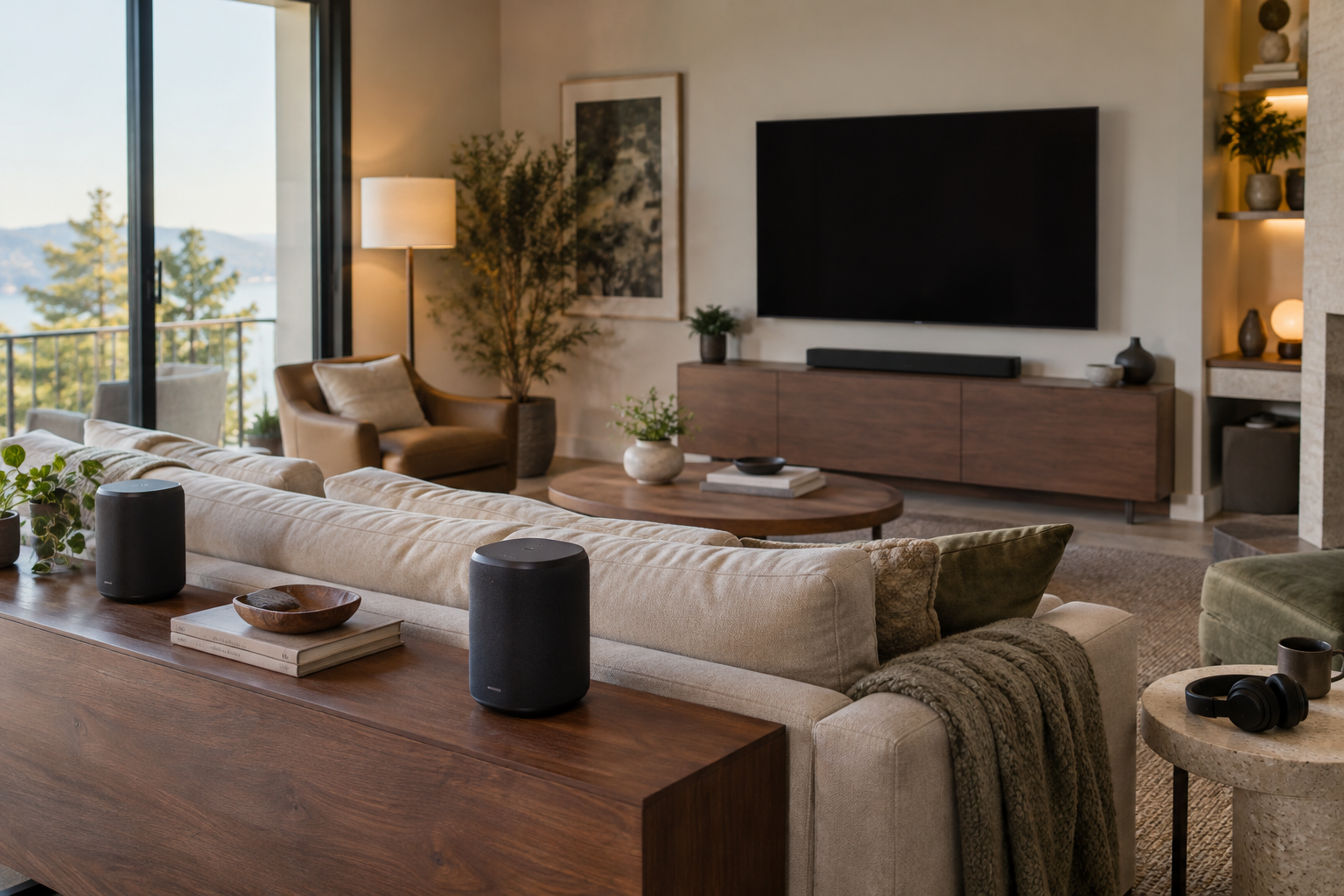
Sonos has outlined an audio platform strategy combining AI control, transferable listening sessions and speakers that change function according to their location. Announced at its September Open House, Sonos 27 brings external AI access into Early Access and broadens the equipment integrators may consider when specifying a whole-home system.
Key facts
- Sonos 27mcp is in Early Access, enabling external AI assistants to discover and operate Sonos equipment.
- Portable Surrounds became available on 8 September 2026 for matching Sonos Play or Move 2 pairs.
- Sonos Ace Ultra and Beam Ultra are scheduled for availability on 29 September 2026.
- Beam Ultra has nine custom drivers and four selectable dialogue-enhancement settings.
- Sonos 27voice is due in Early Access in autumn 2026; Custom Agents are targeted for 2027.
What happened
Sonos has presented Sonos 27 as a shift towards AI-operated home audio, alongside equipment that can move between personal listening, portable playback and cinema duties. Chief executive Tom Conrad outlined the plans on 1 September 2026 in New York City, during the company's inaugural Sonos Open House. The announcements combine features already available with products and services scheduled for later release.
The immediate AI development is Sonos 27mcp, which has entered Early Access. It implements Model Context Protocol, or MCP, an open standard through which AI assistants can communicate with other services and systems. Sonos says this gives an external assistant a route to identify its connected audio products and operate them, rather than limiting interaction to Sonos's own control interfaces.
ChatGPT and Claude are among the AI platforms identified in the announcement. The proposed interaction allows a listener to discuss an artist or musical style, specify a playback room, change listening levels or alter speaker groups within a conversation. Those examples extend beyond choosing a track: they also encompass the room selection and grouping functions that underpin a multiroom installation.
Conrad's demonstration made little use of the Sonos app. That is a relevant distinction for installers assessing the control proposition: the app was not the main interface for the demonstrated interaction. The presentation showed Sonos equipment acting as a system available to an AI assistant, although it did not establish that every installation task or listening function could dispense with the app.
The programme also separates external AI access from Sonos's own assistant development. Sonos 27voice is intended specifically for music and operation of Sonos systems, while Custom Agents form a further, later stage. These are distinct parts of the roadmap, not three names for an already completed service. Their different availability windows matter when separating a current specification from a proposed future capability.
The background
The hardware changes give that software strategy a practical counterpart. Portable Surrounds became available on 8 September, allowing two matching Sonos Play speakers or two matching Move 2 speakers to serve as wireless rear channels. The supported soundbars are Beam Ultra, Arc Ultra, Arc and Beam (Gen 2). The matching-pair requirement and named soundbar compatibility define the equipment combinations described in the announcement.
To activate that role, the portable speakers are placed behind the listening position in the room with the compatible soundbar. Sonos Positioning Technology uses high-frequency audio to determine their location and allocate their function. The positioning mechanism is therefore part of the audio system itself; the announcement describes acoustic location detection rather than a user manually selecting a new role for each speaker.
Removing the speakers from that position returns them to portable operation. Their surround function is consequently not a permanent assignment that removes them from other uses around the home. For an integrator, this introduces a different equipment arrangement from a system built solely around dedicated rear speakers: the same compatible pair can fulfil the portable and surround roles described by Sonos.
Sonos Ace Ultra brings a separate form of movement into the system through Headphone Linking. Initially offered in Early Access, the feature establishes a secure Wi-Fi connection directly between the headphones and a Sonos system. Playback can transfer in either direction between Ace Ultra and compatible speakers, including returning a private listening session to a speaker in another part of the home.
Beam Ultra addresses the television-audio side of the announcement. The compact soundbar contains nine custom drivers and a revised centre-channel design. Its AI Speech Enhancement feature identifies human voices and offers four user-selectable levels of dialogue treatment. These are the stated hardware and processing details; the source provides neither a selling price nor measurements that would support a comparative performance judgement.
What people are saying
Sonos's stated direction is to make its platform aware of the equipment connected to it and responsive to how that equipment is being used. The company is positioning the system as more than a set of networked speakers. Its presentation links control, device location and listening activity, with AI intended to interpret a request rather than merely recognise a prescribed command.
For Sonos 27voice, that means accepting incomplete musical recollections as well as explicit selections. A listener could describe what they remember about a song without supplying its title or performer. Sonos says the assistant is being developed around conversational music requests, making the interpretation of those descriptions part of its intended function rather than requiring the listener to establish the exact search terms first.
The company also describes requests based on an activity or mood, including preparing dinner, hosting friends or settling down for the evening. These examples explain the intended distinction between selecting named content and asking the system to interpret a listening situation. They are examples of the proposed assistant behaviour, not reported results from independent testing of its ability to choose appropriate music.
Sonos does not propose making one assistant responsible for every task. Its Custom Agents plan instead allows different agents to take on specialist roles inside the Sonos environment. The approach leaves room for different AI choices rather than presenting a single general-purpose Sonos assistant as the sole future interface. The announcement sets out that direction without establishing integrations with particular wider home-automation platforms.
For the installation trade, the significance lies in the combination of conversational control and products with more than one function. An assistant can become another route into audio control, while compatible hardware can change its playback role. Related control-platform coverage includes Crestron Home's six-source Multiview addition and Schneider Electric's Apple Home thermostat and HomeView mounts; neither establishes interoperability with the Sonos announcements.
What happens next
The next specified hardware date is 29 September 2026, when both Ace Ultra and Beam Ultra are scheduled to become available. The headphones' release date should be distinguished from the status of Headphone Linking, which starts in Early Access. The announcement therefore provides a product availability date and a separate qualification for the system-linking feature that underpins the new headphone use case.
Sonos 27voice is scheduled to enter Early Access later in autumn 2026. That places the dedicated assistant after the external-AI access already offered through 27mcp. The source gives a seasonal window rather than a specific launch day, and does not state when either AI service will move beyond Early Access. Those limits leave the final rollout timetable unresolved.
Custom Agents carry a 2027 release target. Sonos says users will be able to choose an agent's AI model, personality and voice, providing separate controls over the technology behind it and its manner of interaction. The announcement does not identify a launch month or a supported-model list. For now, those choices belong to the stated roadmap rather than the currently available Sonos feature set.
The source also names Sonos Fabric as part of the company's broader approach, but supplies no technical explanation, compatibility information or release schedule for it. That makes Fabric a named element of the strategy rather than a feature that can be assessed here. It should not be assigned capabilities based solely on its appearance alongside MCP, voice control and the new hardware functions.
For system planning, the announcements expand the relevant product discussion beyond permanently installed loudspeakers. Portable models have a specified cinema role, while headphones gain a route into shared household playback. Those are concrete reasons to consider additional device categories in a Sonos design, while retaining the stated compatibility requirements and distinguishing released functions from Early Access services and the company's longer-term agent plans.
Why this matters
Sonos 27 broadens the specification discussion from fixed speakers to the ways clients move between rooms, private listening and television audio. Integrators have concrete compatibility details for Portable Surrounds and a Wi-Fi handover proposition for Ace Ultra, alongside a less settled AI roadmap. The practical distinction is availability: released functions, Early Access services and 2027 targets should remain separate in project proposals. The announcement supports a wider equipment conversation, but not assumptions about unannounced automation integrations or final AI-service release dates.
Frequently asked questions
- What is Sonos 27mcp?
- Sonos 27mcp is an Early Access implementation of Model Context Protocol. It lets external AI assistants discover and operate Sonos products, with ChatGPT and Claude identified as examples of AI platforms.
- When is Sonos 27voice coming out?
- Sonos plans to introduce 27voice in Early Access in autumn 2026. The dedicated assistant is designed for conversational music requests and Sonos control. No exact launch day is given.
- Which speakers work with Sonos Portable Surrounds?
- Portable Surrounds supports a matching pair of Sonos Play or Move 2 speakers with Beam Ultra, Arc Ultra, Arc or Beam (Gen 2). The speakers become rear channels when positioned behind the listener.
- How does Sonos know where portable surround speakers are?
- Sonos Positioning Technology uses high-frequency sound to locate compatible speakers and assign their roles. Moving the speakers away from the surround position returns them to portable operation.
- When are Sonos Ace Ultra and Beam Ultra available?
- Both products are scheduled for availability on 29 September 2026. Ace Ultra's Headphone Linking feature initially launches in Early Access.
- Can Sonos Ace Ultra transfer music to speakers?
- Headphone Linking connects Ace Ultra directly to a Sonos system over Wi-Fi. It supports transferring playback between the headphones and compatible speakers in either direction.
- What does Beam Ultra add for dialogue?
- Beam Ultra combines a revised centre channel with AI Speech Enhancement. The feature detects human voices and provides four selectable dialogue-enhancement levels. The soundbar has nine custom drivers.
- What are Sonos Custom Agents?
- Custom Agents are planned specialist assistants within the Sonos environment. Users will be able to select their model, personality and voice. Sonos is targeting release in 2027.