HomePal smart home sensors trial explores loneliness in older adults
Researchers have tested a sensor-based system in 70 homes, investigating whether everyday behaviour can help identify loneliness among older people who live independently.

By Eleanor Voss ·
Editor-in-Chief
Researchers at Virginia Commonwealth University and Emory University are investigating whether HomePal, a system combining household sensors and AI, can identify behavioural patterns associated with loneliness. A three-month study involved 70 independently living older adults near Atlanta. The work could inform future support services, but HomePal is not a clinically validated loneliness detection system.
Key facts
- Virginia Commonwealth University and Emory University developed HomePal.
- The study involved 70 independently living participants aged 65 and over in the Atlanta area.
- Researchers collected behavioural data for three months and assessed loneliness every two weeks.
- HomePal combines commercial smart-home equipment with sensors developed specifically for the research.
- Reliable loneliness detection has not yet been established.
- Researchers envisage future versions with local data processing and limits on third-party access.
What happened
US researchers are investigating whether changes in household routines can flag loneliness among older adults before it otherwise comes to attention. Their HomePal system gathers information about daily behaviour through connected devices, with the aim of finding patterns that could prompt further investigation. The intended outcome is earlier support, rather than treating any individual change in activity as proof that a resident is lonely.
Virginia Commonwealth University and Emory University developed HomePal to explore the relationship between behaviour recorded at home and residents’ experiences of loneliness. The research brings connected-home technology and artificial intelligence into an assessment task: determining whether changes in everyday habits can provide useful evidence of loneliness or social withdrawal. That relationship remains something the team is investigating, not an established capability of the system.
The installation combines equipment available commercially with sensors built specifically for the project. This makes HomePal a mixed research system rather than an exercise using only existing consumer products. Alongside developments such as dedicated smart-home hubs, it represents a different use for connected equipment: collecting information that researchers can examine for possible wellbeing indicators, rather than simply providing a household control interface.
The work is described in a paper published in the journal Assessment, covering the development of an AI-enabled remote assessment approach using behavioural information and speech data. Its contribution is an approach to gathering and interpreting information inside homes. Publication does not establish that HomePal can reliably detect loneliness, and the research should not be read as clinical validation of such a service.
The background
The researchers installed HomePal in the homes of 70 people in the Atlanta area. All participants were at least 65 years old and lived independently. Those details define the setting for the work: the team studied older residents in their own homes, rather than describing an installation in a residential care facility or a trial spanning a general, all-age household population.
Behavioural information was collected over three months. That period gave the team a record of routines over time, consistent with its interest in changes rather than isolated readings. The research question concerns whether patterns emerging across that record can be associated with loneliness; it is not presented as an attempt to determine a person’s wellbeing from a single moment of household activity.
Participants also underwent loneliness assessments every two weeks. These provide the comparison against which the researchers are examining the household data, keeping residents’ reported experiences central to the investigation. The study therefore has two distinct strands of information: observations gathered by the technology and repeated assessments of loneliness. Establishing how closely those strands correspond is part of the work, rather than an assumption built into the findings.
What the sensors record
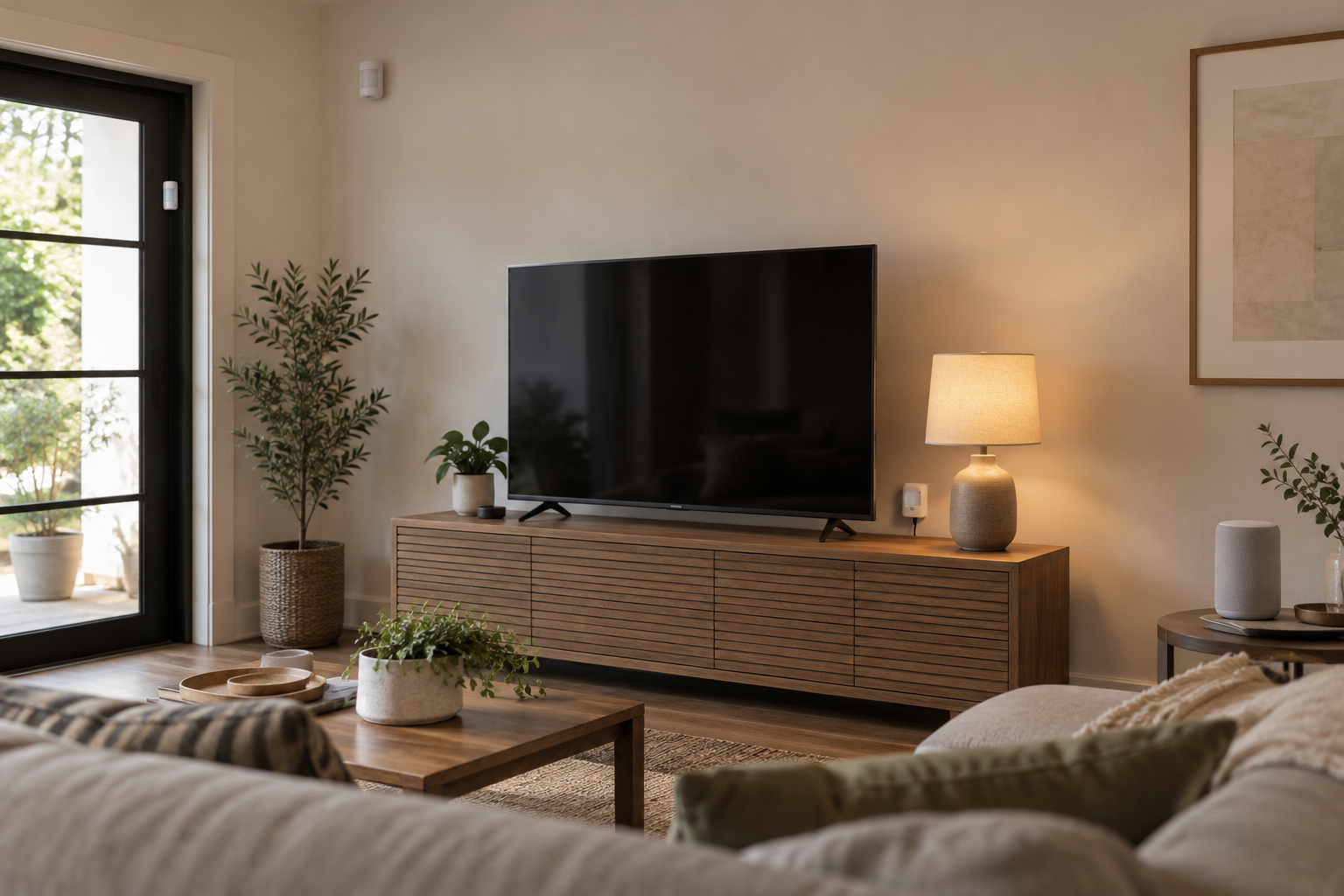
Motion detectors and door sensors supply information about activity inside the property. They form the part of HomePal concerned with movement and household activity, contributing observations to the broader behavioural record. The researchers are not presenting those readings as a direct measure of social connection. Their role is to provide one source of information that can be considered alongside the system’s other inputs.
Smart plugs are used to monitor television use. This gives the study a way to include viewing habits in its account of everyday routines, rather than relying exclusively on movement around the home. Television use is one of the behaviours the researchers want to interpret in context: an increase on its own cannot establish that a participant is experiencing loneliness or needs additional support.
Sleep sensors add information about resting habits. The team identifies disrupted sleep as another example of behaviour that cannot independently demonstrate loneliness. Including it nevertheless allows the researchers to examine rest alongside other daily activities. The distinction is important to the study’s design: the system collects potentially relevant observations, while the research must determine whether combinations of those observations have value for assessing loneliness.
Smart speakers contribute analysis of vocal characteristics, extending the inputs beyond activity and rest. Telephone communication records provide a further indication of social interaction. These are separate sources within the same investigation: one concerns characteristics of the resident’s voice, while the other concerns telephone communication. Together, they broaden the information available for comparison without making either source an established test of the participant’s emotional or social wellbeing.
What people are saying
The researchers’ stated approach is to interpret several behavioural indicators together and follow them over time. They hope this will reveal patterns worth investigating that individual readings cannot establish. The emphasis is therefore on the relationship between different sources of information, not on assigning a fixed meaning to one household habit. A possible signal would warrant further attention; it would not, by itself, settle whether someone is lonely.
For a future deployment, the team envisages equipment installed in a home in a manner comparable to a security system. That describes its proposed installation model, rather than an announced commercial offering. The concept is a residential system that could make changes in a person’s wellbeing more visible, using information gathered within the home to help inform a later decision about whether support may be appropriate.
Privacy is also part of the researchers’ stated plans. They say future versions could keep both information processing and storage within the home, while restricting the information available to third parties. These are possibilities for subsequent development, not confirmed properties of the study installation. Local handling and controlled disclosure are therefore proposed features of the future system, rather than safeguards that the report establishes are already in operation.
What happens next
The team is developing AI models to analyse the collected information and examine its correspondence with participants’ reported loneliness. For integrators following AI developments in the smart-home market, the relevant distinction is between using AI to examine data and demonstrating that its results are dependable. HomePal’s next research task concerns the latter: assessing what the combined observations can actually reveal about the experiences recorded in the study.
Reliable identification of loneliness remains unproven. HomePal is still a research project, and the published work describes a data-collection and interpretation approach rather than a clinically validated detector. The outstanding issue is therefore not simply how to package the equipment for installation. It is whether the analysis can support the proposed assessment purpose, a question that the reported study has not yet resolved.
If the approach proves useful, the researchers envisage information reaching relatives or professional care providers, who could decide whether a resident needs more support. That proposed division of responsibility leaves the decision with people rather than treating the technology as an automatic response system. The potential service would provide information about changes in wellbeing; whether those changes call for intervention would remain a matter for the family or caregiver.
Why this matters
For integrators working on assisted-living projects, HomePal illustrates a possible role for connected equipment beyond household control: gathering information that may help families and care providers recognise a need for support. The boundary is important, however. This study does not establish a dependable loneliness detection service. Any future application would need to address the unresolved reliability question, while local processing and restrictions on data sharing remain proposed features rather than confirmed protections.
Frequently asked questions
- What is the HomePal smart home system?
- HomePal is a research system developed by Virginia Commonwealth University and Emory University. It combines connected-home devices, purpose-built sensors and AI research to investigate behavioural patterns associated with loneliness in older adults.
- Can smart home sensors detect loneliness?
- The HomePal researchers are investigating that possibility, but reliable detection has not been established. The published work describes an approach to collecting and interpreting behavioural data, not a clinically validated loneliness detector.
- Who took part in the HomePal study?
- The study involved 70 independently living people aged 65 and over in the Atlanta area. HomePal collected behavioural data for three months, while participants underwent loneliness assessments every two weeks.
- What devices does HomePal use?
- HomePal uses motion and door sensors, smart plugs for monitoring television use, sleep sensors and smart speakers that analyse vocal characteristics. Telephone communication records provide another source of information about social interaction.
- Does HomePal keep personal data inside the home?
- The researchers say future versions could process and store information locally and restrict third-party access. The report presents these as possible future features, not confirmed safeguards in the study installation.
- How could HomePal help families and caregivers?
- The researchers envisage a future system that provides information about changes in a resident’s wellbeing. Relatives or professional caregivers could use that information to decide whether additional support is needed.
- Does watching more television mean someone is lonely?
- No. The researchers say increased television use cannot establish loneliness on its own. They are investigating whether several behavioural indicators, examined together over time, can reveal patterns that warrant further attention.